

Vance Center Co-Hosts Climate Litigation Panels at 2026 Climate Week NYC
The Vance Center's Environment Program partnered with the Sabin Center for Climate Change Law to organize two panel discussions exploring climate litigation developments at the domestic and global levels.

Event organizers and speakers from the first panel at the joint Climate Week NYC event, held at the New York City Bar, September 23, 2026. Photo credit: Vance Center
On September 23, the Vance Center’s Environment Program and Columbia Law School’s Sabin Center for Climate Change Law co-hosted an in-depth discussion, “The Evolving Landscape of Climate Litigation: U.S. and Global Perspectives” as part of the 2026 Climate Week NYC.
During two panels, leading climate litigation experts examined major cases and emerging legal strategies in the United States and across the world. The event brought together more than 120 academics, legal practitioners, scientists, and civil society representatives in person, along with 100 virtual attendees.
Speakers on both panels described a new phase of climate litigation in which courts are clarifying and defining the climate obligations of governments and companies, while litigators work to turn those legal standards into concrete action. They also pointed to ways that political opposition and institutional and implementation challenges continue to test the effectiveness of litigation efforts.
Vance Center Associate Executive Director and Environment Program Director Susan Kath offered opening remarks, highlighting the Vance Center’s longtime partnership with the Sabin Center and its work with civil society organizations and legal professionals worldwide. She underscored the legal community’s responsibility to protect civic space and human rights, and to uphold the rule of law.

Attendees listen to panelists speak at the first panel focused on U.S. climate litigation, September 23, 2026. Photo credit: Vance Center
Panel 1: Climate Litigation in U.S. courts: The (Im)balance of Powers
The first panel traced U.S. climate litigation from the Supreme Court and federal regulatory system to state action and climate tort cases. Michael Burger, Executive Director of the Sabin Center, moderated the conversation with speakers Skye L. Perryman, President and CEO of Democracy Forward; Sambhav (Sam) Sankar, Senior Vice President of Programs at Earthjustice; Bethany Davis, Visiting Assistant Professor at Vermont Law and Graduate School; and Katrina Fischer Kuh, Haub Distinguished Professor of Environmental Law at the Elisabeth Haub School of Law at Pace University.
Burger opened the panel by introducing panelists and highlighting the Sabin Center’s extensive climate litigation resources, including its Climate Litigation Database, which was relaunched during Climate Week NYC last year.
The Vance Center assisted the Sabin Center with updating the database. This virtual tracker provides researchers and practitioners with important information on more than 3,000 climate litigation cases in 70 jurisdictions around the world.
Panelists urged the climate lawyers in the room to look beyond traditional environmental legal frameworks. They emphasized how disputes over executive authority and federal agencies, as well as state power and access to the courts, determine how governments can develop and enforce climate policy.
Perryman started with an analysis of the federal judiciary, emphasizing how lower federal courts continue to check executive action and raising concerns about the federal government’s growing use of the Supreme Court’s emergency, or “shadow” docket. She noted how the Court has used emergency orders to put lower-court decisions on hold, rather than for their intended use of preserving the status quo while cases move forward.
“More often than not, right now, we’re seeing the Supreme Court actually use the shadow docket to disturb the status quo,” she said.
Perryman encouraged climate lawyers to keep an eye on shifts in administrative and executive power, including national security and emergency powers, which can shape federal climate policy far beyond the current administration. In response to a question on court reform, she underscored the importance of public pressure and political will to drive forward proposals on an enforceable ethics code and on docket reform.

From left to right, moderator Michael Burger of the Sabin Center joins speakers Skye Perryman of Democracy Forward, Sam Sankar of Earthjustice, Bethany Davis of the Vermont Law and Graduate School, and Katrina Fischer Ku of the Elisabeth Haub School of Law, September 23, 2026. Photo credit: Vance Center
Sankar broadened the discussion to address the role courts play in informing climate policy. He identified three key functions: overseeing government agencies, determining how longstanding laws such as the Clean Air Act and Clean Water Act apply to new challenges, and navigating the balance of power among Congress, states, the executive branch, and the courts.
However, he advised against viewing litigation only as a way to restore earlier regulatory systems. He argued that recent political shifts and weakened government capacity have made regulatory action less durable, so climate cases must also show the public how environmental protections affect their lives and strengthen support for lasting legislative and political change.
“Litigation has to be about the project of building political will,” Sankar said.
Turning to state action, Davis highlighted states’ strong position to challenge federal action because of how federal decisions can directly affect their budgets, regulatory programs and policies. She pointed to a record of success, noting that state attorneys general won 83 percent of the energy and environmental cases they brought against the first Trump administration, and emphasized that states across the political spectrum have used litigation to protect their authority and interests.
Davis also covered how states are using their own powers to enforce environmental protections and address climate costs. She pointed to New York and Vermont’s climate superfund laws, which seek to allocate costs to companies that contribute to climate harms, helping cover adaptation and cleanup efforts. Ultimately, she explained, these cases must connect legal action to concerns people share across political lines and see in their everyday lives, like clean air and clean water.
“Even though we’re in a conversation about litigation, we should be talking about what people care about, and that is what will fuel these cases and get them to the right place,” she said.
Burger shifted the discussion to state-level climate lawsuits, asking Kuh to outline the potential impact of the Suncor Energy Inc. v. County Commissioners of Boulder County case, scheduled for oral arguments before the Supreme Court on October 5, 2026. Kuh explained that the case raises questions about whether federal law limits states’ abilities to pursue claims of climate harm linked to fossil fuels under their own laws. She noted that the Supreme Court ruling could also affect more than 30 similar cases pending in state courts.
The panel wrapped up with a cross-panel discussion on emerging areas of climate litigation, including growing concerns about data centers, followed by a brief audience Q&A. The speakers underscored the importance of continuing to use litigation to show communities that laws can address tangible harms and hold powerful actors, like corporations and governments, accountable.
After a brief networking session, audience members returned to their seats for the second panel, on climate litigation developments at the international level.

Dr. Maria Antonia Tigre of the Sabin Center (far left) speaks with panelists at the second panel on global climate litigation. From second to left: Lucy Maxwell of the Climate Litigation Network, Elaine Johnson of Johnson Legal / Australian Environmental Lawyers, Florencia Ortúzar of AIDA, and Nikki Reisch of CIEL, September 23, 2026. Photo credit: Vance Center
Panel 2: Establishing and Implementing Climate Obligations Globally
Moderated by Dr. Maria Antonia Tigre, Director of Global Climate Litigation at the Sabin Center, the second panel examined how climate litigation has evolved across international jurisdictions.
Tigre highlighted how major decisions from domestic, constitutional, regional, and international courts have shifted the litigation landscape from asking whether governments have legal obligations to address climate change to considering what those obligations require in practice, including around government and corporate accountability.
The panel featured insights from Lucy Maxwell, Co-Director of the Climate Litigation Network; Nikki Reisch, Director of Climate & Energy Programs at the Center for International Environmental Law (CIEL); Florencia Ortúzar, Director of the Climate Program at the Interamerican Association for Environmental Defense (AIDA); and Elaine Johnson, Director of Johnson Legal / Australian Environmental Lawyers.
Maxwell discussed recent government climate litigation, identifying key principles that courts across jurisdictions have more consistently recognized over the past decade. She described growing recognition that governments must set science-based emissions targets consistent with limiting warming to 1.5 degrees Celsius, develop clear and feasible plans to reach them, and ensure they are implementing those targets. Maxwell pointed to recent rulings in countries including South Korea, Germany, France, the United Kingdom, and Ireland, as well as decisions from regional and international courts.
She added that newer cases are testing those principles as governments fall behind their targets and weaken commitments.
“It’s not good enough just to have vague long-term plans because the real risk is that those measures don’t happen, and that ultimately that emissions reduction burden falls on future generations,” she said.
Maxwell then highlighted the growth of climate cases against corporations like Shell and TotalEnergies. These cases have asked courts to consider whether private law and due diligence obligations can require companies to address the climate impacts of their activities, and to address the key question of remedies in these matters.
Reisch discussed the growing range of cases seeking accountability for climate harm. She divided them into two broad categories: cases seeking to make polluters “stop polluting” and ones to make polluters “pay.” She emphasized that accountability can extend beyond financial compensation.
She connected those cases to the International Court of Justice’s 2025 advisory opinion on human rights and climate change, which moved climate reparations “from the margins to the mainstream” by affirming that existing rules of state responsibility and human rights also apply to climate harm.
Ortúzar drew on AIDA’s climate litigation and work with ruling on environmental matters to highlight innovations and challenges around climate jurisprudence in Latin America. She described the persistent gap between securing favorable environmental rulings and implementation as a structural issue. She noted how existing procedural systems often constrain responses to complex environmental disputes that extend beyond a single decision. She encouraged litigators to address that implementation gap by considering implementation from the start, identifying concrete and achievable remedies, and involving communities and scientists when building cases.

Elaine Johnson speaks at the second panel focused on developments in global climate litigation, held at the New York City Bar, September 23, 2026. Photo credit: Vance Center
Turning to Australia, Johnson discussed the Denman case, the first climate case to reach Australia’s High Court, and concerns associated with the case surrounding the expansion of Mac Energy’s New South Wales coal mine. Johnson noted that the case raises questions around whether planning authorities must consider the local climate impacts associated with its greenhouse gas emissions and stressed the tangible costs for communities, including negative health impacts, higher insurance costs, and extreme weather events.
“If you’re going to make a decision as significant as expanding a coal mine for another 28 years, we’re going to require you to factor in all of the local impacts,” she said.
Johnson offered examples of progress and setbacks in regional climate litigation.
In the Australian case, the legal team introduced climate science and the ICJ advisory opinion – issued just 12 hours earlier – into proceedings, leading the High Court to consider the local effects of fossil fuel development. In contrast, after New Zealand’s Supreme Court allowed climate-related tort claims against several companies to proceed, Parliament changed the law to prevent courts from holding parties liable for climate harms associated with greenhouse gas emissions, stopping the case before it reached trial.
In closing, speakers emphasized that courts are developing a stronger body of climate law, while litigants face difficulties implementing judgements due to legislative efforts to limit climate claims, attacks on climate science, and other forms of pressure against groups pursuing accountability. They agreed that litigation’s value extends beyond an immediate judgement. It can help communities tell their stories, gather important evidence and information, and build collective action efforts.
“The most successful legal cases are those that come from movements and communities that are defined and shaped by them, and that are received by those communities who can use even what looks like a loss in the court as a win,” said Reisch.
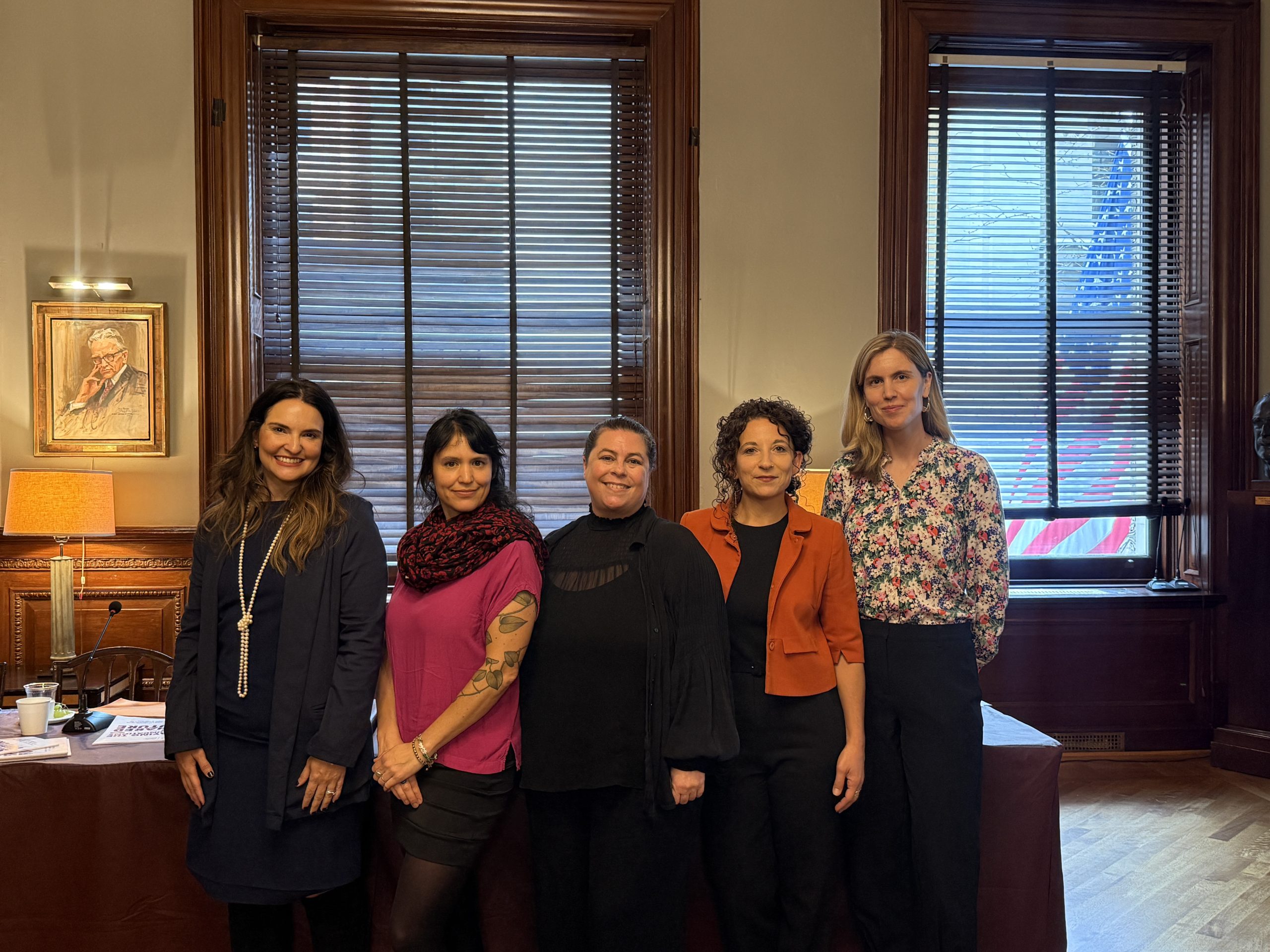
Global panel discussion moderator and speakers at the joint Climate Week NYC event on September 23, 2026. Photo credit: Vance Center